When gum disease advances far enough to erode the bone and tissue holding your teeth in place, routine cleanings cannot undo that damage. The goal shifts from managing disease to rebuilding what was lost, and that is precisely what regenerative periodontal procedures are designed to accomplish.
At Rockland Dental Specialists, our periodontics team, led by board-certified periodontist and implant specialist Dr. Shalom Mintz and Dr. David Peto, brings over 24 years of combined experience to every case. When regeneration is the right path forward, we create a personalized treatment plan to restore the foundation your smile depends on.
What Periodontal Regeneration Actually Means
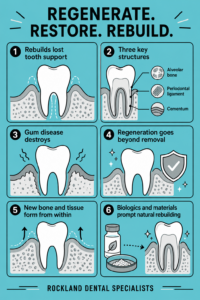
Regenerative periodontal procedures target the structures that support your teeth: the alveolar bone, periodontal ligament, and the cementum layer on the root surface. These are the tissues that advanced gum disease systematically destroys over time. Rather than simply removing infected tissue, regenerative procedures create the biological conditions your body needs to rebuild those structures from within.
This is an important distinction. Conventional surgical treatments can halt disease progression, but they do not restore what has already been lost. Regenerative approaches go further by introducing materials and biologics that actively prompt your body to form new bone and attachment tissue in areas where it has broken down.
The Techniques Behind Regenerative Treatment
Our periodontists and implant specialists draw on several proven methods depending on the nature and severity of each patient’s bone and tissue loss.
Bone Grafting
One of the most foundational elements of a regenerative approach is bone grafting. When periodontitis erodes the bone surrounding a tooth root, a graft material is placed into the defect to provide a scaffold that supports new bone formation. Grafts may be sourced from your own body, a tissue bank donor, or a synthetic substitute, with each option offering biological properties suited to the specific defect.
The graft itself does not create bone. Instead, it preserves the space within the defect and signals bone-forming cells to migrate into the area and begin rebuilding. This is why the stability of the surgical site during healing is so critical to a successful outcome.
Biologics and Growth Factors
Some osseous surgery cases benefit from the addition of biologics that enhance the body’s natural repair response. Platelet-rich fibrin, derived from a small sample of your own blood, concentrates growth factors that accelerate tissue regeneration. A systematic review and meta-analysis published in the National Institutes of Health’s PubMed Central found that platelet-rich fibrin shows real osteopromotive potential, though current evidence does not support using it alone as a substitute for bone grafting in larger defects. That is consistent with how it is generally used in practice: as a complement to grafting rather than a replacement for it, particularly in cases involving more compromised healing environments.
These biologics are often used alongside bone grafts to support faster, more complete tissue regrowth and may be particularly beneficial for patients whose healing capacity is affected by health conditions or medications.
What to Expect Before and After Your Procedure
Regenerative procedures are typically performed after scaling and root planing has thoroughly cleared the area of bacterial buildup. During the surgical phase, the gum tissue is carefully opened, the defect site is prepared, regenerative materials are placed, and the area is closed to allow undisturbed healing. This sequence matters because introducing regenerative materials into a site that still carries an active infection significantly reduces their effectiveness.
Recovery follows a structured schedule. Your first follow-up appointment typically occurs within two weeks of surgery, and a second check-in usually happens around eight to ten weeks post-surgery. Most patients are then seen every three months for the first year to monitor healing and maintain periodontal health. After that first year, patients may alternate every three months between our office and their general dentist for ongoing periodontal maintenance.
Frequently Asked Questions About Regenerative Periodontal Procedures
What is the difference between regenerative periodontal surgery and traditional gum surgery?
Traditional periodontal surgery, such as pocket reduction, is designed to stop active gum disease from progressing and make the area easier to keep clean. Regenerative procedures go a step further by introducing bone graft material and biologics into the defect so your body can rebuild the alveolar bone, periodontal ligament, and other supporting tissue that disease has already destroyed, rather than simply halting further damage.
How long does recovery take after a regenerative periodontal procedure?
Healing happens in stages. Most patients return for an initial follow-up within about two weeks of surgery, with a second evaluation around eight to ten weeks later. Soft tissue typically closes over within several weeks, while the underlying bone graft continues to mature for a number of months, so your periodontist will schedule visits over the first year to monitor that progress.
Is bone grafting always part of a regenerative procedure?
Not in every case, but it is one of the most common building blocks of regeneration. Graft material gives new bone a scaffold to grow around, and your periodontist determines whether grafting is needed, and which source makes sense, based on the size and shape of the defect found during your evaluation.
What role does platelet-rich fibrin play in regeneration?
Platelet-rich fibrin is prepared from a small sample of your own blood and concentrates growth factors that support tissue healing. Research shows it has real osteopromotive properties, but current evidence does not support relying on it alone in place of a bone graft for larger defects. For that reason, it is typically used alongside grafting rather than as a stand-in for it.
Does regenerative treatment work for every case of gum disease?
Regeneration tends to work best for specific patterns of bone and tissue loss, and generally once any active infection has been cleared through scaling and root planing. A periodontist evaluates the shape of the bone loss during an exam to determine whether a regenerative approach, a different surgical technique, or a combination is the right fit.
Take the Next Step at Rockland Dental Specialists
Our team at Rockland Dental Specialists shares one vision: to earn each patient’s trust and deliver the highest quality, personalized care. Dr. Mintz’s board certification in periodontics and implantology, combined with advanced technology and a high-end, stress-free office environment, means your treatment is both precise and comfortable. With 24/7 availability and complimentary insurance verifications, we make it easy to get the care you need when you need it most.
If bone or tissue loss is putting your teeth at risk, we are here to walk you through your options and design a plan tailored to you. Contact us today to schedule your consultation and take the first step toward restoring your periodontal health.